Grand Pier 1 Win
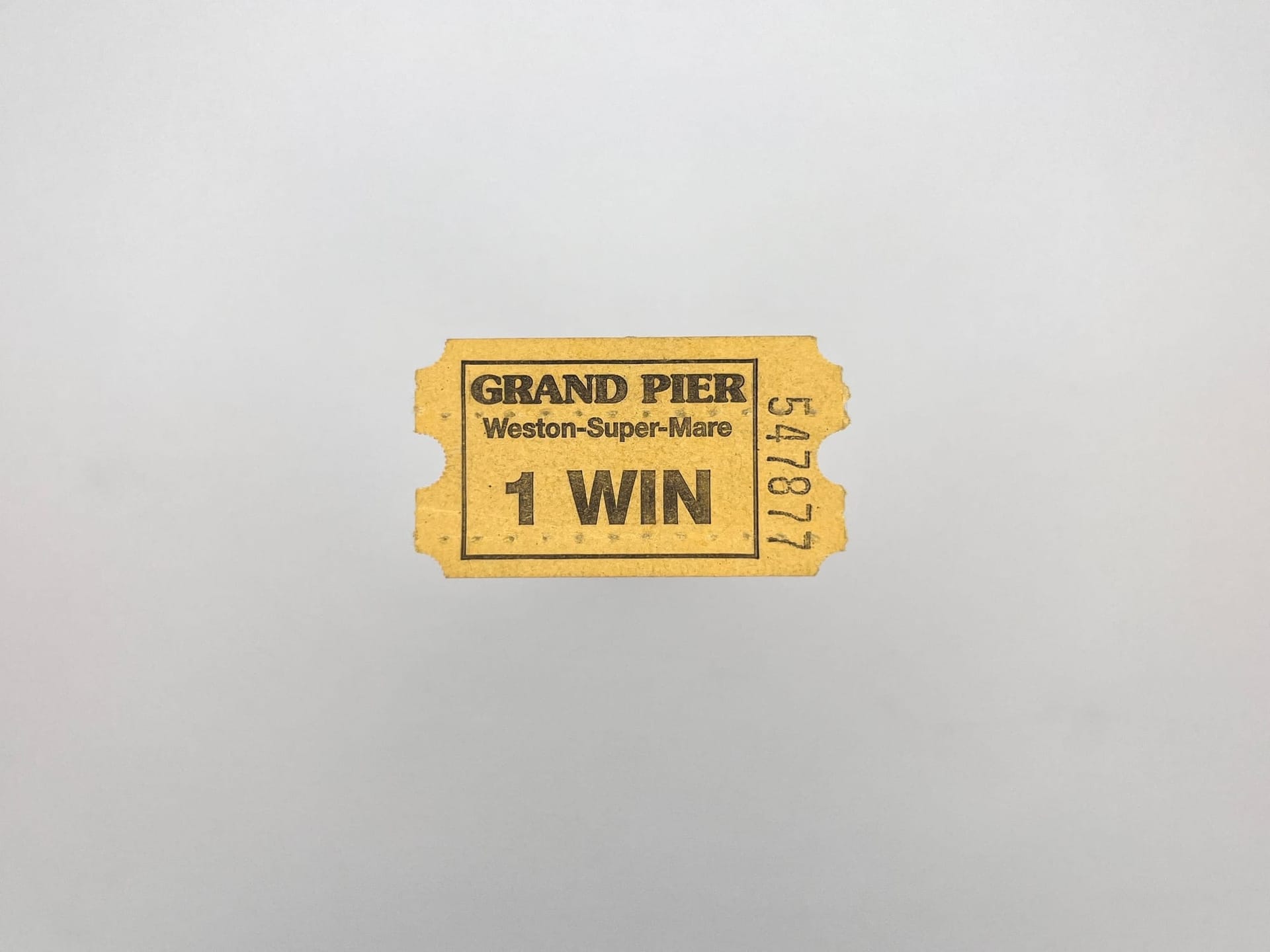
I've no idea how, when, or where I got this, but I know that I've liked it every time I've re-found it. There's so much tied up in a little old ticket like this, and so many design details too that I think make it special.
Tied up, emotionally, are thoughts and memories of going to seaside towns, playing on piers and at fun fairs, and 'winning' something, even if just a tiny ticket that you can't use to redeem a real prize with unless you win even more of them.
It's like an original type of gamification. A trick to give you a little dopamine hit and encourage you to get more. This ticket is so much more innocuous and cute though compared to the tricks played digitally today. Oh! Simpler times.
From a design perspective, while it's a very minimal piece of print, every single detail has a purpose, and the sum of those parts make for the brilliant aesthetic. Not greater than the sum (I oddly take issue with that saying which I've explained here), but as close as you can get to every fibre and spot of ink being necessary and perfect.
You couldn't design a better ticket for this job basically. It's a ticket for the GRAND PIER and the slightly fancy font used for the name suits it well. Then, more subtly, you need to know the ticket is from Weston-Super-Mare incase some scallywag tries to collect tickets from multiple piers (I assume the rule is that you can only redeem tickets from where they were won).
1 WIN is nice and big to really punch that dopamine home, and then the fine line box to contain all that information and make it feel framed, connected and considered.
That serial number down the side is clearly just a practical matter, but there's even something nice about the asymmetry to the boxed text, and the fact that it's clearly printed in another ink as part of a separate printing process. It makes me wonder also if ever these numbers were necessary for a prize winning validation, or even what purpose they had at all. Who wanted to know how many there were, or which number this one was? What did that information tell someone? What was their job and remit?
Finally, the paper stock which is slightly mottled and nice and fibrous. While surely just a cheap paper that you can print loads of, it gives a quality and intrinsic value to the ticket, adding to the value, and forming a large part of why I likely save and valued its design myself.
And those tiny little dots you can just see. I imagine they're imprinted by the ticket machine dispenser. Two little pointy cogs that turn a certain number of times in order to issue each ticket. It makes me wonder also about the entire mechanism of those machines. They must have been a classic design that remains unchanged to this day, if there are still any about. A dispenser that someone perfected for this single special job.
Finally – I nearly forgot while focusing on the print and imprint on the paper – The shape. It looks decorative and fancy, which again adds to the special nature of the win, but I bet it's purely practical, in order to minimise the number of perforated contact areas, to ensure the tickets are torn off perfectly and not in half (or in a way that might mistakenly tug more out than you've been allotted).
As for the mystery of where I got it from, I really can't think. I'm not even sure I've ever been to Weston-Super-Mare, though I know of it well from my Westcountry childhood.
It's a semi-famous seaside town, so it's talked about in that way. And there's the fact the name sounds so weird and almost braggadocios. Like an expletive infixation, like abso-fucking-lutely.
There was also a legendary BMX track there in the 80s, with a bridge that riders rode over and under. I desperately wanted to try it. Never did though, sadly. By the time we started venturing outside of Devon for our BMX expeditions it had been knocked down.
While writing this, I quickly searched for anything I might find about the old BMX track and amazingly came across this old home video of the Weston super Mare BMX National 1988, 12 Yr Old Boys Semis
It's very hard to hear (or see – isn't it amazing to revisit the poor quality of Hi-8 video recordings), but the winner of the second race is Beijing 2008 Olympics Team Sprint gold medal winner Jamie Staff. And in second and third are Dave Cash and Jason Nichols, who are old friends from my early 90s BMX racing days. Dave's younger brother Ian in fact was my first key adversary when I started racing. A lovely guy. but I desperately wanted to beat him, and get at least 1 WIN...